At NTEA’s Work Truck Week this year, Adrian was named the recipient of the Upfit of the Year award for its work on the ADT Maverick fleet. If you missed the announcement, you can find it here.
This is the story behind the award-winning vehicle.
Anyone with experience in commercial vehicles understands that while the coveted trophy may be simple to describe, it’s incredibly challenging to attain. Judges don’t award the Upfit of the Year merely for tidy shelving and a fresh coat of paint.
Instead, this recognition is reserved for vehicles that have been meticulously crafted with the end user in mind — where every detail reflects thoughtful engineering, and the finished product reveals a level of consideration that goes far beyond surface improvements.
The Job Before the Vehicle
Before a single component was spec’d, the Adrian team needed to understand what the ADT technicians’ day actually looks like.
They’re security system installers. That means they show up to homes and businesses carrying a lot of different specialized tools, equipment, and consumables: sensors for doors and windows, cameras, high-value electronics that don’t respond well to being jostled against a pipe wrench, wiring and wire management tools, and ladders, which in ADT’s case not just one ladder but multiple ladders, in multiple sizes: a four-foot step ladder, a six- or eight-foot step ladder, and a sixteen-foot extension ladder.
ADT’s fleet transformation marked a significant shift—from relying on the Transit Connect, a compact van, to adopting the Ford Maverick, a small pickup with a notably shorter bed and distinct dimensions. This change presented unique challenges, as there was no existing upfit solution that could simply be transferred to the new platform. As a result, the Adrian team had to rethink the entire upfit process from the ground up.
To gain an authentic understanding of the technicians’ daily routines, Rachel Kuhn, Fleet Account Executive, and Sales Engineer Justin McBurnett embarked on site visits to ADT branches in Lenexa, Kansas and the Miami area. Their mission was intentionally broad: dive deep into every aspect of the technicians’ workday. Rachel explained, “We were taking photos, gathering measurements, learning about consumables, figuring out what they carry, how they carry it, and why. We even asked how often they visit the warehouse and what their typical day looks like in the field.”
At the heart of their approach was a simple yet powerful philosophy: vehicle upfits shouldn’t start by focusing on the vehicle itself but should begin with a thorough understanding of the people who use it. By prioritizing the technicians’ needs and habits, the team laid a strong foundation for designing a solution that would truly enhance their workday.
The Rubik’s Cube
Here’s where it gets interesting.
Each upfit project presents a unique set of challenges, often centered around decisions such as where to place shelves, which drawer units to incorporate, and how to configure bins. The difference between an upfit that simply functions and one that earns accolades lies in how these constraints are managed when they inevitably clash. For the Maverick, these conflicts were a recurring theme, requiring innovative solutions and careful balancing to achieve a truly exceptional result.
The ladder problem. A sixteen-foot extension ladder doesn’t fit inside a Maverick. Neither does a four-foot step ladder in any straightforward way. Justin’s solution for the step ladder required mounting it on the back of the toolbox, tucked as high as possible because the Extendobed beneath it needed clearance for wire boxes. The height required meant the ladder couldn’t exit the topper in a straight line. It has to drop. The topper door was designed specifically to enable that.
And that’s just one ladder. There are three others.
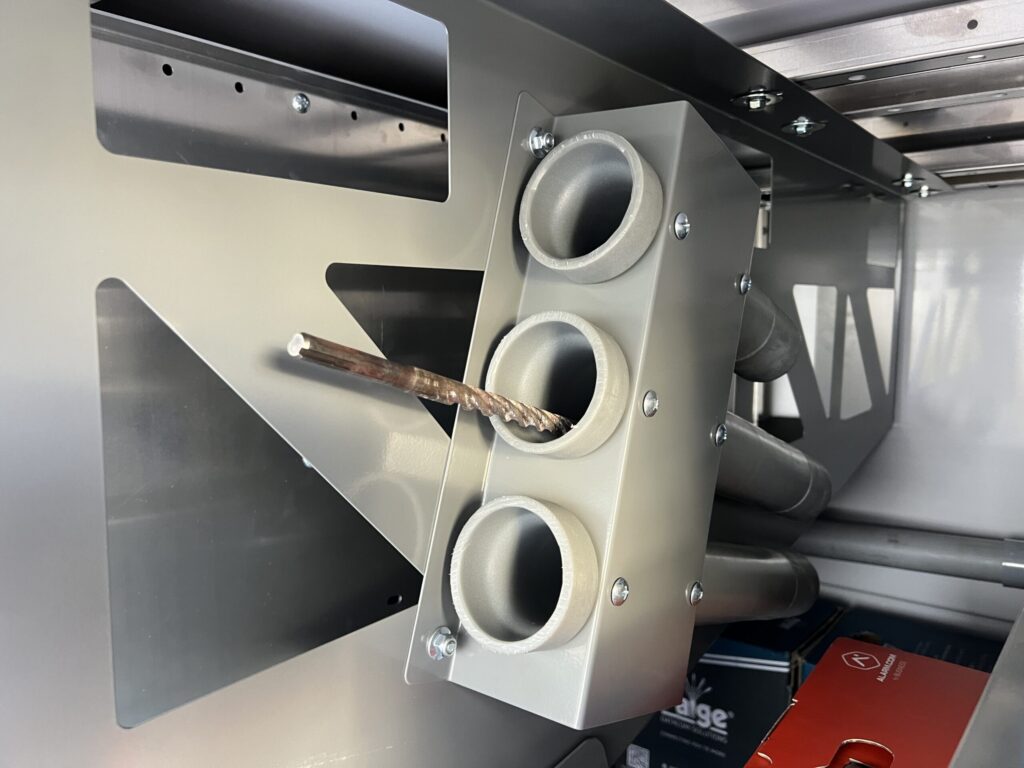
The glow rod problem. ADT technicians carry glow rods (also called fish sticks) for fishing wire through walls. Standard glow rods are six feet long. The Maverick’s bed is four-and-a-half feet. Justin engineered a custom bent conduit carrier that redirects the rod at an angle into the available space. Total clearance between the end of the rod and surrounding components: approximately one inch.
The sign holder problem. ADT trucks carry company signage. The sign holder had to be large enough to accommodate the actual signs but that created a new issue: signs shifting during transit. The solution became a retention bungee added to the holder after field testing revealed the problem.
The high-value equipment problem. Security cameras and sensors are expensive, fragile, and can’t be co-mingled with heavy tools. The solution was to route high-dollar items into the lockable toolbox, which also doubled as the base structure for the ladder mounting system. And because the toolbox sits in the bed, Adrian developed a custom alarm system for the topper to protect everything inside.
Each of these solutions is logical in isolation. Together, they represent a vehicle that has been thought through at a level most people will never see.
The Process Behind the Product
What Rachel described as the design process is, in itself, worth understanding.
After the site visits, Justin developed initial CAD concepts. Then the team moved to reviews of the proposed design that let ADT stakeholders actually see the solution before anything was built.
Then came four pilot vehicles which were built, deployed to field locations in Kansas City and the Miami area, and evaluated by the technicians who would actually use them. The feedback from those pilots drove another round of refinements: electronic locks were upgraded, lighting was added, the alarm solution was finalized, side panels were added to the Extendobed to prevent consumables from falling into the truck bed, and the bungee system for the toolbox was introduced.
One more virtual review. Sign-off. And then production.
ADT needed approximately 454 upfitted Mavericks. Adrian ran production at roughly 75 vehicles per week out of its Kansas City facility and finished ahead of schedule. During that same window, the team was also managing a 150-unit interim order that went out while the final design was still being refined, because ADT had hired a large technician cohort and couldn’t wait.
The coordination required, between Adrian’s engineering team, the production floor, Ford’s delivery schedule, and ADT’s branch network, is the kind of thing that doesn’t show up in a photo of the finished vehicle. But it’s what makes the finished vehicle possible.
What “Award-Winning” Actually Means
When Jimmy, ADT’s Senior Director of Fleet Operations, came out to sign off on the pilot vehicles, he wasn’t reviewing a proposal. He was reviewing a solution his own teams had helped shape over the better part of a year through site visits, feedback rounds, and virtual walkthroughs.
That kind of partnership doesn’t happen by accident. It happens because one side of the relationship decided, from the first site visit, that the goal wasn’t to sell a shelf kit. The goal was to understand the job.
Rachel put it this way at the end of the process: “Just seeing it come from ‘What is this?’ to the vehicles being out on the roads doing what they were designed to do.”
The Upfit of the Year award celebrates not just the finished product, but the thoughtful and meticulous process behind it. It’s about the custom conduit carrier engineered with just an inch of clearance, the specially designed topper door allowing a ladder to drop safely, the VR headset used remotely at a leadership meeting so everyone could review the solution firsthand, and the 150 trucks deployed ahead of schedule to meet urgent staffing needs.
These details aren’t just what set the project apart—they’re what ensure technicians remain efficient, secure, and ready for the demands of their workday.
Ultimately, this is the standard the team strives for: building solutions that go beyond expectations and truly empower those relying on them every day.
Interested in what a custom upfit process looks like for your fleet? Contact us today.